Sea Cow's tunnel
The Jungle BookSea Cow's tunnel is the hidden underwater route through which Kotick reaches the safe rookery that transforms the fate of the seals. Concealed beneath coastal cliffs and known only through the movements of Sea Cow, it links the open sea to beaches inaccessible to human hunters. The tunnel therefore functions not merely as a natural curiosity but as a passage from repeated danger to collective refuge: once Kotick has proved its existence and defended the destination, nearly ten thousand seals follow him through it, and the migration continues to grow in later years.
Physical Structure and Discovery
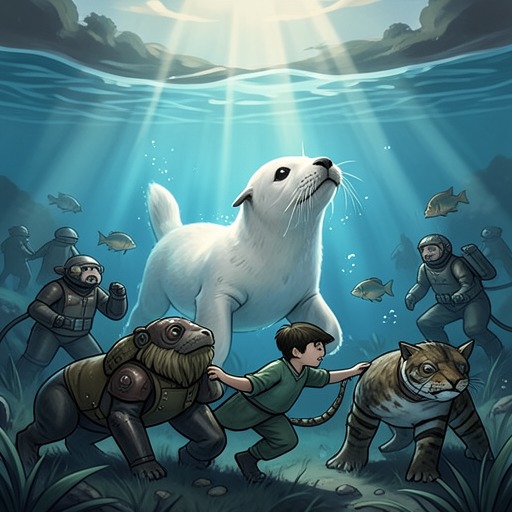
Sea Cow's tunnel is encountered only after Kotick recognizes the strange creatures he has found as Sea Cow. The sea cows cannot speak because, according to the account, they have only six bones in the neck where they should have seven; they communicate instead through movements of an extra joint in the foreflipper, a clumsy form of underwater signaling. Their silence makes the route difficult to understand, while their slow, ceremonial behavior tests Kotick's impatience and forces him to observe rather than command.
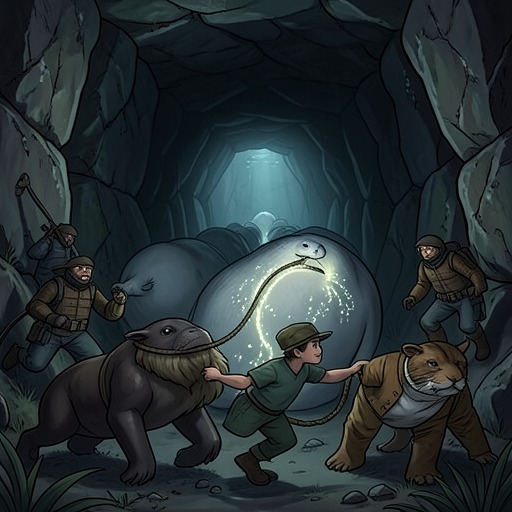
The herd travels north along the shore, rarely covering more than forty or fifty miles in a day. It follows a warm current and periodically stops for bowing councils. Kotick initially regards the sea cows as foolish because of their slowness, but the current reveals that their movement is purposeful. One night the herd suddenly dives and swims rapidly toward a coastal cliff. At the cliff's base, twenty fathoms beneath the surface, an opening leads into a dark tunnel. Kotick follows them through the long passage and emerges gasping into open water on the far side.
His startled response marks the tunnel as a discovery rather than an ordinary feature of the coast. No human would have suspected an entrance beneath the cliffs, and even Kotick finds it difficult to believe, when looking back at the rock face, that he has passed underneath it. He subsequently dives to confirm the mouth of the tunnel and races through it southward, establishing that the passage is a usable route rather than a single accidental escape.
The Route to a Safe Rookery
The tunnel opens onto beaches unlike the exposed nurseries Kotick has known. Smooth-worn rock extends for miles in forms suited to seal nurseries; hard-sand playgrounds slope inland; rollers, grass, and dunes offer space for seals to move and rest. The water is clean of the signs that would betray human occupation, and Kotick recognizes from its feel that no men have ever reached the coast.
The surrounding geography provides several layers of protection. Low sandy islands lie half hidden in the fog, while bars, shoals, and rocks stretch northward offshore and prevent ships from approaching within six miles of the beach. Deep water lies between the islands and the mainland, and the cliffs rise so steeply that men could not descend them even if men were present. The tunnel's hidden mouth completes this defensive arrangement: the rookery is protected from the sea by reefs and shoals, from the land by cliffs, and from ordinary sight by the underwater passage itself.
Kotick first tests the practical value of the place by checking that fishing is good. Only after confirming food, nursery ground, play areas, and defensive access does he judge the site secure. He compares it with Novastoshnah, but finds it ten times better. The comparison gives the tunnel a clear function in the larger story: it does not create an abstract paradise, but supplies the specific conditions required for seals to live, breed, and escape the slaughter that threatens the old rookeries.
Kotick's Return and Proof
Kotick spends time exploring the new country so that he can answer questions when he returns. The need for such preparation is important because discovery alone does not persuade the other seals. He swims back in six days, despite not traveling slowly, and the seal waiting for him reads the discovery in his eyes before he explains it. His knowledge is therefore first carried as personal conviction, then offered as testimony to a skeptical community.
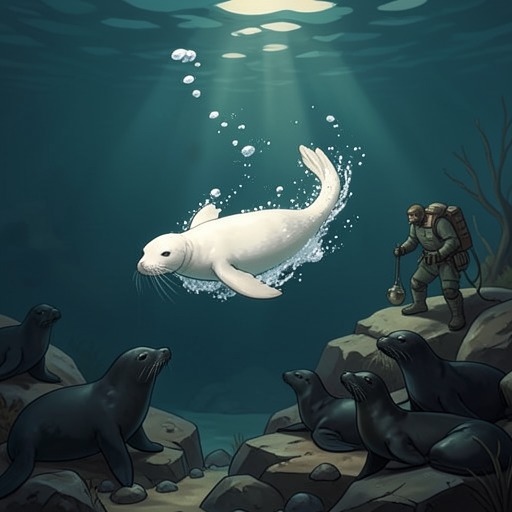
The seals at Novastoshnah reject the report. Sea Catch and the others laugh at Kotick, while a younger seal argues that he has no right to order established nursery grounds abandoned because he has never fought for them. The tunnel's existence is not enough to overcome tradition, pride, and the authority of seals who have survived by defending the old beaches. Its social importance must be demonstrated through action.
Kotick returns to the issue after fighting the seals who mock him. When the combat leaves the nurseries scattered and bleeding, Sea Catch acknowledges both the severity of Kotick's victory and the possibility that the promised island exists. The old seal agrees to accompany his son, converting the tunnel from a solitary claim into a destination that the older generation is willing to inspect.
Migration and Consequences
After the fight, Kotick calls on the seals to follow him to the tunnel. Thousands answer that they will come, and a week later he leads an army of nearly ten thousand holluschickie and old seals northward. The passage thus becomes a collective threshold: before it, the seals are divided between those who trust Kotick and those who remain at Novastoshnah; after it, the followers possess a route toward a protected settlement.
The migration is not completed in a single movement. The seals who remain behind call the travelers idiots, and the species' slowness in changing its mind means that persuasion takes years. Yet the new rookery's safety becomes self-reinforcing. Each spring, seals meet off the Pacific fishing banks, and those who have passed through the tunnel tell of the beaches beyond it. More seals then leave Novastoshnah, Lukannon, and the other nurseries for the sheltered coast.
The tunnel's lasting consequence is therefore demographic as well as geographic. It enables a continuing movement away from exposed breeding grounds toward a place where no man comes. Kotick remains there through the summer, growing bigger, fatter, and stronger while the holluschickie play around him. The hidden passage preserves not only individual lives but the possibility of a safer seal community organized around access to a space that human violence cannot easily reach.
Narrative and Thematic Significance
As an object, Sea Cow's tunnel embodies the difference between seeing a danger and finding a way around it. The old nurseries are defended through repeated fighting, but the tunnel offers a more durable answer: not victory within the threatened space, but departure from it. Kotick's achievement depends on exploration, patience, geographical reasoning, and finally leadership, so the passage joins natural secrecy to deliberate collective action.
The tunnel also establishes a boundary between human knowledge and animal knowledge. Men have not mapped or used the route; Sea Cow's bodily difference and silent signaling preserve it from ordinary human understanding. The seals, however, learn its function through observation and movement. What appears inaccessible from the human world becomes legible within an animal community, giving the nonhuman characters an independent geography and an agency not dependent on human recognition.
Its significance is completed by the return journey. Kotick does not discover the tunnel merely to escape alone. He explores it thoroughly, verifies its resources, faces ridicule, wins a fight that compels attention, and leads others through the route. The tunnel becomes the physical center of a new pattern of life: a concealed entrance, a protected coast, and a migration that gradually replaces the old, dangerous rookeries with beaches where the seals can live beyond the reach of men.